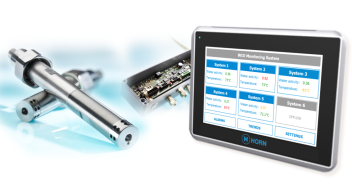
Water absorption in oil, sensor


About the product
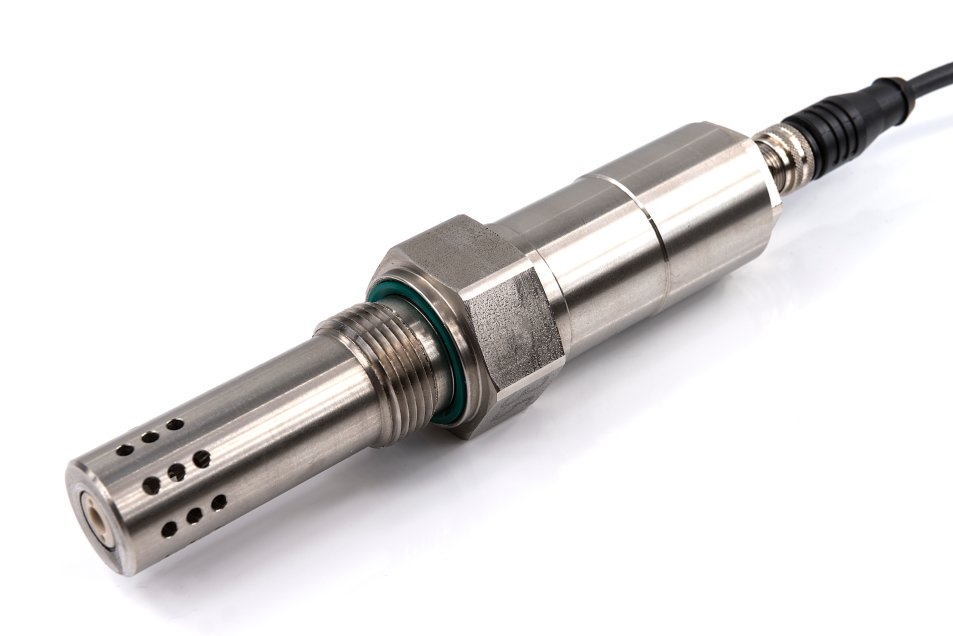
Sensor that uses capacitance to measure water absorption in oil. It does not measure free water but absorbed water before saturation point and formation of water particles, which affects lubrication in machines and equipment
. The physical measured value is the so-called “water activity value” “AW”. Oil has the ability to hold a certain amount of dissolved water. The maximum amount of water that oil can hold is called the “saturation point”. Above the “saturation point”, free water will precipitate out, which can cause corrosion inside the engine.
The “saturation point” is affected by temperature and other factors such as the composition of the mineral or synthetic oil, the formulation of additives, and will change over the life of the oil.
Typically, water-in-oil content is measured in-situ with a water-in-oil test kit. These kits can only measure the percentage of oil in water, usually based on room temperature, which does not provide information about the saturation of the oil with water! The water-in-oil (WiO) sensor does not measure free water or emulsion, which can be detected by standard water-in-oil test kits. It measures the absolute water content of the oil.
The context between humidity and “AW” is x AW * 100 = x % humidity. A PAV (pre-alarm value) of 0.5 AW means 50% humidity, while a MAV (main alarm value) of 0.9 AW means 90% humidity. More than 100% (or 1.0 AW) means free water, and from this point on, standard water-in-oil test kits start measuring. If the WiO shows main alarm, the value is higher than 90% (the oil is 90% saturated with water).
Typical applications
-
Energy
-
Process
-
Hydraulics & Mechatronics
-
Condition monitoring
-
Machine & Propulsion
Manufacturer

About the product
Sensor that uses capacitance to measure water absorption in oil. It does not measure free water but absorbed water before saturation point and formation of water particles, which affects lubrication in machines and equipment
. The physical measured value is the so-called “water activity value” “AW”. Oil has the ability to hold a certain amount of dissolved water. The maximum amount of water that oil can hold is called the “saturation point”. Above the “saturation point”, free water will precipitate out, which can cause corrosion inside the engine.
The “saturation point” is affected by temperature and other factors such as the composition of the mineral or synthetic oil, the formulation of additives, and will change over the life of the oil.
Typically, water-in-oil content is measured in-situ with a water-in-oil test kit. These kits can only measure the percentage of oil in water, usually based on room temperature, which does not provide information about the saturation of the oil with water! The water-in-oil (WiO) sensor does not measure free water or emulsion, which can be detected by standard water-in-oil test kits. It measures the absolute water content of the oil.
The context between humidity and “AW” is x AW * 100 = x % humidity. A PAV (pre-alarm value) of 0.5 AW means 50% humidity, while a MAV (main alarm value) of 0.9 AW means 90% humidity. More than 100% (or 1.0 AW) means free water, and from this point on, standard water-in-oil test kits start measuring. If the WiO shows main alarm, the value is higher than 90% (the oil is 90% saturated with water).
Contact
-
Jorn Jul-Larsen
Manager, Sales & Marketing, Agency
+47 95 87 00 22 -
Roy Dahl
Sales Engineer, Agency
+47 95900734